
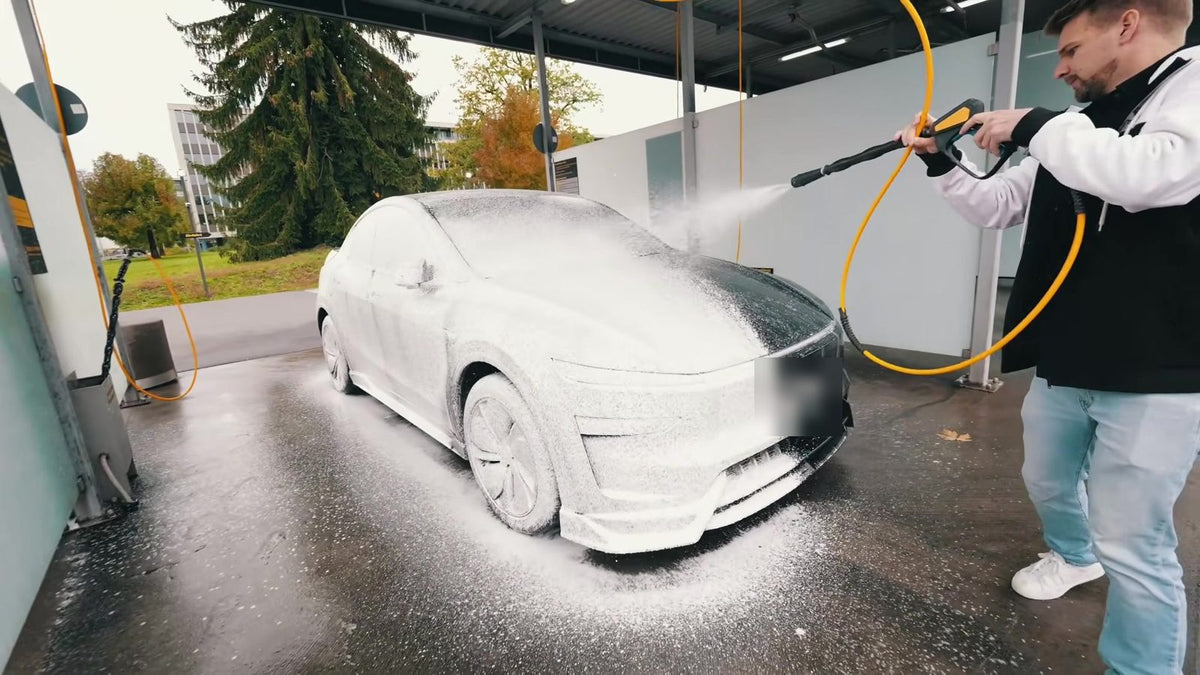
A Tesla is actually an easy car to wash: no exhaust, no oily film on the rear, big smooth panels. Yet we keep seeing the same marks – fine scratches on a black roof, water spots on the glass roof, a camera that reports "limited" right after a wash. It's almost never the car. It's the order you work in and the tools you use.
Here's the routine we use to hand wash a Model 3 or Model Y (and, with small differences, an S or X), including the points Tesla itself sets out in the Owner's Manual and the small habits that make the real difference.
Before you start: what Tesla says
The "Cleaning" chapter of the Owner's Manual has a few clear rules. The ones that matter most for a hand wash:
- Don't wash in direct sunlight and don't use hot water – cold or lukewarm is fine.
- Use a mild, high-quality car shampoo. No highly alkaline or caustic cleaners (for example anything with hydroxide), and no acidic products either. Tesla gives pH 13 as the upper limit.
- No chemical wheel cleaners and no chemical pre-wash products. This is the one most people miss.
- Pressure washers only from at least 12 inches (30 cm), nozzle always moving, never aimed straight at parking sensors (if fitted), window, door or hood seals, or electronics.
- Soft, high-quality microfiber instead of rough or tight-napped cloths.
Sounds strict, but it's exactly what a gentle hand wash looks like anyway.

Step 1: Turn on Car Wash Mode
Car Wash Mode (Controls > Service > Car Wash Mode) is worth using at home too. According to Tesla, it closes all windows, locks the charge port and turns off the wipers, Sentry Mode, walk-away door lock and parking sensor chimes. The car has to be stationary and not charging.
Why it matters in your driveway: without it, the rain sensor can start the wipers while you rinse, and the car may lock itself while you walk around it with wet hands. The mode switches off once you drive faster than 9 mph or tap Exit.
Step 2: Rinse thoroughly first
It's Tesla's own first step: flush off loose dirt and grit with a hose, especially in the wheel wells and panel gaps. In winter, add the underbody, wheel wells and brakes, because that's where road salt sits.
Work from the top down. If you use a pressure washer, 12 inches is the minimum, not the target. Around cameras, door seals and the charge port flap, stay further back and spray at an angle.
Step 3: Pre-wash with foam – shampoo, not chemicals
Foam is the best insurance against wash scratches: it softens the dirt before your mitt ever touches the paint. Since Tesla advises against chemical pre-wash products, we simply use a solution of pH-neutral shampoo.
We fill the 7WASH Cordless Foam Sprayer with water and a splash of 7WASH Car Wash Shampoo. The sprayer runs at a maximum of 3.6 bar (about 52 psi) – far from what a pressure lance can do to cameras or seals. Spray it on, let it dwell for a few minutes (don't let it dry), then rinse from the top down.

Step 4: Hand wash with two buckets
One bucket with shampoo water, one with clean water to rinse the mitt. A grit guard at the bottom keeps the sand down there. We explain the idea in detail in our guide to the two-bucket method.
- Mitt or cloth: Tesla advises against rough, tight-napped cloths and recommends microfiber. We use a soft, deep-pile microfiber wash mitt like the one in the 7WASH Car Wash Shampoo Set. It pulls dirt into the fibers instead of dragging it across the paint.
- Order: glass roof, windows, hood, rear, upper sides – rocker panels, lower bumpers and wheels last.
- Straight lines, light pressure: circular motions leave exactly the round swirls you see later in the sun.
- Rinse after every panel. If the mitt hits the ground, it's done for the day – grab a clean one.
Video: how we wash our own Tesla Model Y – foam, hand wash and rinse. The wash part starts at 2:43. Watch the video on YouTube
Cameras and sensors
A Model Y has cameras above the front grille (newer cars), above the rear license plate, in the door pillars, in the front fenders and behind the windshield. Tesla recommends spraying the lenses with water and drying them with a microfiber cloth – no chemical or abrasive cleaners, nothing sharp. In wet weather Tesla suggests cleaning them every week, in dry weather once a month.
Our tip: keep a separate, clean microfiber cloth just for the lenses, one that has never touched a rocker panel.
The glass roof
The glass roof is the biggest piece of glass on the car and shows every mistake. Wash it like paint with shampoo and a mitt, rinse well and dry it first, before the water dries on its own in the air or sun. If your water is hard, mineral spots form fast otherwise.
Wheels without wheel cleaner
Because Tesla rules out chemical wheel cleaners, we wash the wheels with the same shampoo solution, a soft wheel brush and a separate mitt. EVs produce less brake dust thanks to regenerative braking – more on that in our EV washing guide.
Step 5: Final rinse
Rinse thoroughly with clean water so no shampoo dries on the surface. At the frunk, trunk and door seals, don't point the hose straight at them – let the water run down from above.
Step 6: Dry before spots appear

Lay a large 7WASH Drying Towel (60 × 90 cm, about 24 × 35 in) on the panel and pull it towards you instead of rubbing. One towel is usually enough for a whole Model Y. Then go over the details with a small microfiber cloth: mirrors, door handles, cameras and the edge under the frameless windows, where water likes to drip out. More technique in our guide to drying a car.
Tesla mentions one more step that's easy to forget on an EV: after washing, dry the brakes with a short drive and a few firm stops. Because a Tesla slows down mostly through regen, the brake discs often get little use, and surface rust forms more easily on wet discs.
Step 7: Frunk, trunk and seals
Once the car is dry, open the frunk, trunk and doors. Water and dirt collect in the channels and along the seals. Wipe them with a damp, then a dry microfiber cloth. Keeping rubber seals clean and dry matters more than any dressing – and in winter it stops doors and lids from freezing shut.
Step 8: Glass and protection
- Windows: Tesla recommends an automotive glass cleaner and rules out scraping and abrasives. 7WASH Glass Cleaner works on windows, mirrors and the glass roof – for camera lenses, stick to water.
- Paint protection: If you like, mist a thin layer of Ceramic Quick Sealant after the wash and buff it off. Water beads off far better afterwards and the next wash is quicker. On a professional ceramic coating or film, only use what your installer approves.
- Between washes: For light dust, Waterless Wash & Wax and two microfiber cloths are enough. With salt or sand, always start with water.
The most common mistakes we see
- Forgetting Car Wash Mode – and the wipers start.
- Getting close to cameras, the charge port or door seals with a pressure lance.
- Strong wheel cleaners or pre-wash chemicals, even though Tesla advises against them.
- Washing in the sun, so the glass roof dries with spots.
- One cloth for everything – from the rocker panel to the camera lens.
What we use
- 7WASH Cordless Foam Sprayer 12V – pre-wash with shampoo foam
- 7WASH Car Wash Shampoo Set – pH-neutral shampoo and microfiber wash mitt
- 7WASH Microfiber Drying Towel – for paint and the glass roof
- 7WASH Premium Microfiber Cloth – cameras, mirrors and seals
- 7WASH Glass Cleaner – windows and glass roof
- 7WASH Ceramic Quick Sealant – quick protection after the wash
Want everything in one box? The 7WASH Complete Car Care Kit with foam sprayer has it covered.
FAQ
Can I use a pressure washer on a Tesla?
Yes, but keep at least 12 inches away, keep the nozzle moving and don't aim straight at parking sensors, seals or electronics. Never spray high-pressure water towards the charge port while the car is charging – Tesla is explicit about that.
Do I need Car Wash Mode for a hand wash?
It's not required, but it helps: windows stay closed, the wipers stay off and the charge port stays locked. No surprises while you rinse.
Which shampoo is safe for a Tesla?
A mild, high-quality car shampoo without strongly alkaline or acidic ingredients. Our Car Wash Shampoo is pH-neutral and made for paint, plastic, glass and coated surfaces.
How often should I wash my Tesla?
It depends on weather and driving. In winter with road salt, every one to two weeks; in summer, spot-clean bugs and bird droppings straight away. Tesla advises removing corrosive dirt like bird droppings, tree sap or road salt immediately rather than waiting for the next full wash.
Tesla details are taken from the Owner's Manual (Cleaning chapter) as of November 2026. Details can vary by model, year and software – if in doubt, the manual in your car applies.